Tyron Arnett
Brock Smith
4-5-20
In this week’s lab, we observed cat home range tracking data from the United States, Australia, and New Zealand. An organism’s home range is the physical area covered by its daily movements to obtain food, seek shelter, or find mates. Both of us collected data from fifteen different cats in each country. This came to a total data from ninety cats. We first found the cat data on the database of MoveBank.org. We then exported this data into Google Earth Pro to visualize the home range of these cats. We then created a polygon representing the home range of each cat and exported that data into EarthPoint in order to calculate the data and produce the area of each cat’s home range in Hectares. We then created a bar graph to compare the home ranges of each country. We then ran a one-way ANOVA test using our cat data. The P-value that came from our ANOVA test was 0.019. This P-value is less than 0.05 which means that there is a significant difference between the home ranges of cats depending on their country. In the second part of this lab we read an article about the ecological role of cats.


PART I
1.) What were the average home ranges for cats in each of the countries? Make a bar graph of the average home ranges by country. Include error bars.
-USA cats averaged the highest home range at 7.2 hectares
-New Zealand cats had an average home range of 2.9 hectares
-Australian cats had an average home range of 4.48 hectares
2.) Based on your observations in Google Earth, what types of habitats were in the cats’ home range?
-The biome that the cats home range took place was the temperate deciduous forest. The habitats that were involved in the cat’s home ranges were forest, ocean, and grassland.
3.) How did the cat’s location (urban, rural) influence it’s use of the landscape? NOTE: Think about parts of the landscape that the cats appear to avoid, spend the most time in, etc.
-The cat’s location played a huge role on how they used the landscape. When their homes were in urban areas they tend to take farther trips, meaning they lived in a resource poor environment. Urban areas usually were filled with busy roads, the production of new homes or stores, and too many people. Which isn’t all the fitting for cat and their needs. Rural areas are where the cats normal ended up on their voyages. From the observations in Google Earth, the cats tended to flow towards places with a high number of animal diversity. Those places were normal animal reservations, trails, and forest habitats. The cats also tried to stay away from places that contain a large body of water, but went near lakes and rivers for food.
4.) What abiotic and biotic factors might influence the size of the cats’ home range?
-Temperature at the time could be a huge abiotic factor, cold temperatures would result in cats having little home ranges. Droughts also could be an abiotic factor that will impact a cat’s home range because that can resemble a resource poor environment for animals. A biotic factor that would influence a cat’s home range is the number of prey and predators within their journey.
5.) Based on the cats’ home ranges in your data set, what might that suggest about cats’ potential impact on local biodiversity.
-Cats are big threat to conservation because they kill lots of animals. Cats going into different environments eating off the little puts a shortage on other animal’s resource of food. Causing species to look elsewhere for food resources causing a shift in the environments whole food chain.
6.) You are an urban developer interested in designing a city safe for both cats and local biodiversity. Based on the cat’s home ranges, what landscape changes might you implement to accommodate cat’s roaming behavior while protecting local wildlife?
-I’d put up more gating that will separate the urban area from wildlife protecting local wildlife from cats. Also produce more open areas so that cats can fulfill their free roaming needs. Or even steal the idea of a bird feeder and create a cat feeder which will pull cats to a distinct location for food.
PART II
Find a peer review article about the ecological role of cats. Summarize the study’s objectives and overall findings (DO NOT QUOTE DIRECTLY FROM THE TEXT. USE YOUR OWN WORDS). How do the study findings compare to your observations of the cat tracker data? Be sure to make a meaningful connection. If you can’t do so, then you should find another research article.
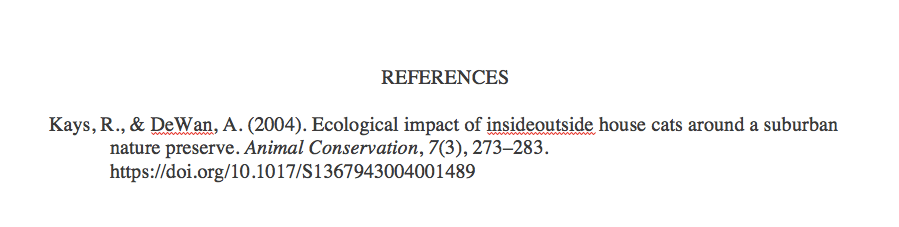
-The researchers in the article Ecological impact of inside/outside house cats arounda suburban nature preserve wanted to determine what type of impact that the hunting house cats were having on the ecology of their home ranges. They found that there was an average of 0.275 Inside Outside House Cats (IOHC) per house. (Kays, 2004) These IOHC averaged 1.67 prey per home per cat per month. (Kays, 2004) They found that there was no significant relationship between the number of cats in an area and the number of wild animals in an area. They speculated that the ecological impact of these cats was minimized by cold weather and cat predator populations. They also found that the cats had relatively small home ranges that rarely overlapped with forested areas. They found that most of the cats hunting activity occurred within these small areas as well. The cats in the study mainly stuck to their own properties or ventured into their neighbor’s gardens. This is consistent with our data that the cats generally stick to familiar territory and do not venture too far from their home range which minimizes their ecological impact. The researchers hypothesized that the cats are less likely to affect the surrounding populations because of their reliance on human reaction. (Kays, 2004) It requires less energy for a cat to be reliant on humans for nourishment than to have to hunt for it on their own. These domesticated cats are not driven by hunger and therefore do not greatly affect the ecology of their home ranges. I believe this is also the reason that our cat home ranges were relatively small. I would hypothesize that the cats’ home ranges would become larger if deprived of food.
Tyron Arnett is responsible for the graphs and PART I. Brock Smith is responsible for the introduction paragraph and PART II.
 Tyron & Brock BIOL 3070