Tyron Arnett
Brock Smith
3-29-20
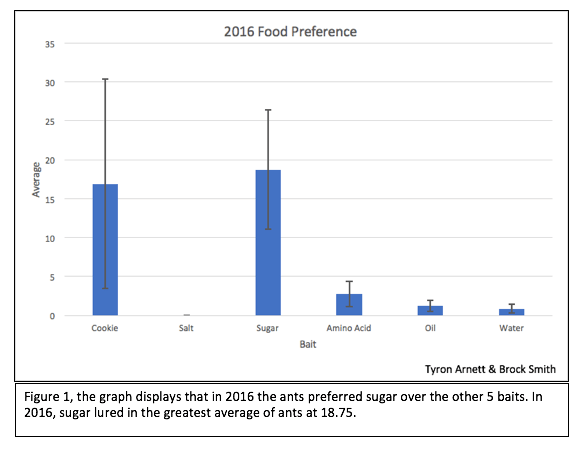
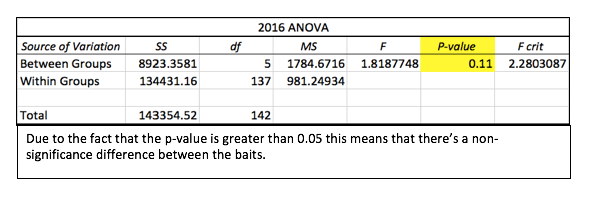
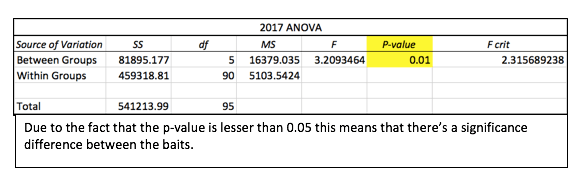
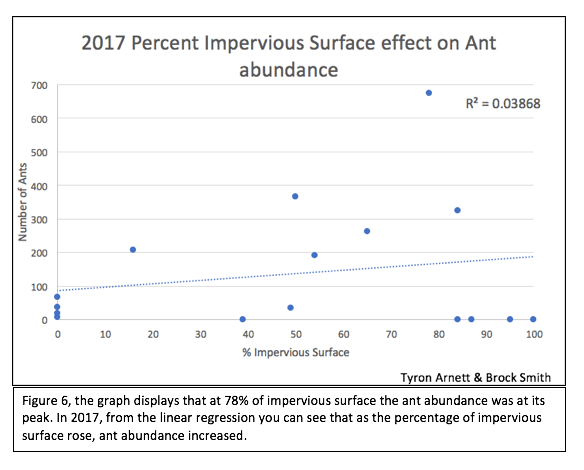
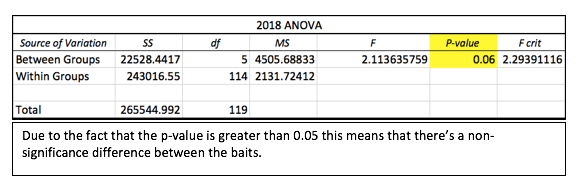
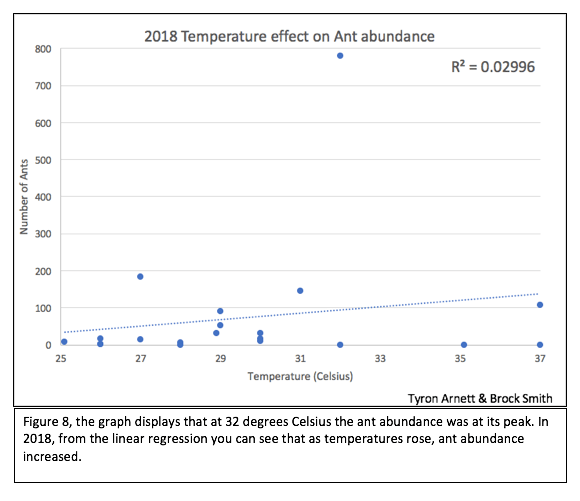
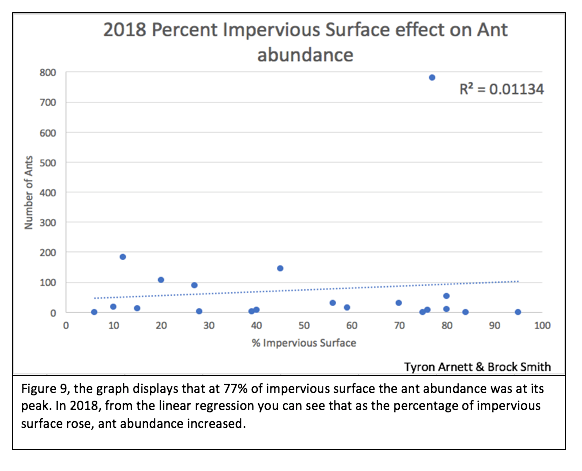
In this week’s lab, we analyzed ant picnic data from 2016-2018. In the experiments that we analyzed former students conducted a study to determine which food sources attracted more ants in the urban environments. Each group selected four sites around the University of Tennessee-Chattanooga to gather their data. They each selected two green sites and two pavement sites. The researchers placed 6 baits at each site containing sugar, salt, water, oil, cookie, and amino acid. After an hour, the groups returned to the testing sites and gathered the baits in plastic bags to collect the data. We created bar graphs for each year comparing food preferences. We then created a scatterplot analyzing the effects of temperature on the number of ants’ present. We then created another scatterplot analyzing the effects of percent impervious surface on the number of ants’ present. We then performed a one-way ANOVA on the preference of food for each year. Our p-value from the ANOVA test was 0.11 which means that that there was not a significant difference among the preference of baits from year to year. In the second part of our lab we learned about a similar experiment carried out in New York City that compared ants with rats and other foragers and their impact on the trash left in the city streets. We also learned about a study in which researchers were estimating economic and environmental benefits of urban trees in desert regions. We also learned about a study in which researchers observed the response of rats to the introduction of cats and the efficiency of cats as predators of rats.




PART I
1.) Briefly describe what you understand to be the goal of the data collection. What hypotheses are you testing?
-The goal of the data collection was to get a better understanding on urban ecology. Which is the scientific study of the relation between living organisms and their surroundings in the context of an urban environment. We also wanted to distinguish what type of effect does temperature play on food preference for ants. Also, what type of effect does temperature and percent impervious surface have on ant abundance through various environments. After the effects of increase temperature and percent impervious surface the ant’s will prefer the cookie over the other baits.
2.) Give a brief explanation of how the study was carried out and what was measured. You should include a simple description of the study design, what variables were measured, and what were the units of measure. How were these variables measured? How many times was the experiment repeated in your group? In the class overall? Discuss anything that went wrong during the study.
-Sample ants at 6 distinct locations around UTC campus. Measuring temperature, calculating percent impervious surface, and measuring urbanization to test the hypotheses on the effect of urban environments on ant food preferences. The data that was collected was the location of the bait, coordinates of the bait, time bait was set out, time bait were collected, temperature in Celsius, percent impervious surface, and various baits. Temperature was measured with a thermometer. To keep track of when the bait was sat out, collected, and the total time, they used a clock. Percent impervious surface was collected by dividing number of steps on pavement over total number of steps. Lastly the bait was tallied every time an ant picked that particular bait. From the look of the data collected each group ran the experiment 4 times. I can’t really elaborate on what went wrong during the study because I never conducted it. Due to the coronavirus, I was never given the opportunity to conduct it, only analyze the data from previous groups.
PART II
Read the New York Times article (Links to an external site.) on food preference in urban animals. Consider the following questions in your blog entry:
1.) What factors might explain the similarities and differences between your data analysis and those from the NY study?
-In New York the results of sugary foods being preferred were similar to the Chattanooga Study. The New York study allowed for greater accuracy in data due to allowing the organisms more time to forage. The New York study also had two different feeding setups in order to account for and compare the influence of other fauna on the feeding of the ants.
2.) Recent studies have suggested that urban areas are good for biodiversity. Under what circumstances might cities help increase biodiversity? HINT: Think about the size and connectedness of green spaces in an area.
-Urban areas can help improve biodiversity by building more parks and planting more greenery. This would provide more habitat. They can also help increase biodiversity by providing ways that organisms can safely pass between these habitats.
3.) In addition to ants, what type of organism do you think would be well adapted to cities? Vulnerable?
-I think that birds are well adapted to cities because they are not restricted to areas due to barriers such as roads. They are also able to move great distances in the event of new construction or drastic changes in the landscape that affect resources. I would say that amphibians are probably poorly suited to urban environments. They are reliant on water sources that can easily be contaminated. They have nowhere to go if that water source is reduced or eliminated.
4.) How might humans help improve the function of cities as an ecosystem?
-Humans can help improve the function of cities as an ecosystem by acknowledging that cities are an ecosystem. As stated in the 2014 journal article Cultural ecosystem services as a gateway for improvingurban sustainability “Successfully protecting green infrastructure in locations also attractive for urban development requires deliberate processes of planning and policy formulation as well as broad public support”. If humans gathered data on what organisms lived in a particular city they could then make specialized plans to help the populations of organisms. This will take rules and regulations but everybody must be informed on the organisms living in the city to support and follow these programs and regulations. Some general things humans could do would be to minimize littering that can be harmful to organisms and make more habitats available of them.
Frontiers in Ecology and Evolution: Urban Ecology
Urban ecology is a rapidly growing field that will continue to provide insight into urban ecosystem processes. Read two abstracts on the Frontiers in Ecology and Evolution Urban Ecology page (Links to an external site.) and answer the following questions for each abstract
Estimating Economic and Environmental Benefits of Urban Trees in Desert Regions
1.) Briefly summarize the study question and findings. What did you find interesting about the study?
-The researchers in this article wanted to analyze the economic and environmental benefits of three tree species in urban areas. They analyzed data of Acacia tortilis, Ziziphus spina-christi, andPhoenix dactylifera. They found that Acacia tortilis had the highest overall benefits. I found it very interesting that the impact that trees have on carbon reduction is equivalent to $14 billion annually.
2.) As a science communicator, what key takeaways should the general public be aware of based on your readings?
-The main takeaway from this study is that it is extremely beneficial and important to have trees within our urban areas. They improve many environmental factors as well as making urban areas cleaner and more efficient.
3.) What questions would you ask the authors about their study?
-I would ask the authors if they think that they would see similar data and results across many different climates in many other cities. How much of an impact does regional climate have on the benefits of trees? For example: Would the trees make as much of a difference in cold climates such as Northern Canada?
Temporal and Space-Use Changes by Rats in Response to Predation by Feral Cats in an Urban Ecosystem
1.) Briefly summarize the study question and findings. What did you find interesting about the study?
-The researchers in this article analyzed the behavior of rats when predatory cats are introduced into their environments. I found it interesting that cats did not actually prey on rats that often during their study.
2.) As a science communicator, what key takeaways should the general public be aware of based on your readings?
-The main takeaway from this article was that although the rats were seen less it wasn’t because the cats were feasting on rats. The rats simply changed their behavior to avoid the cats and be more elusive. This indicates that cats are not a great pest control method for rats as is commonly thought.
3.) What questions would you ask the authors about their study?
-My main question for the researchers from this article would be if they think that their results would be similar in a rural ecosystem.
Tyron Arnett is responsible for the graphs and PART I. Brock Smith is responsible for the introduction paragraph and PART II.

 Tyron & Brock BIOL 3070