Tyron Arnett
Brock Smith
3-8-20
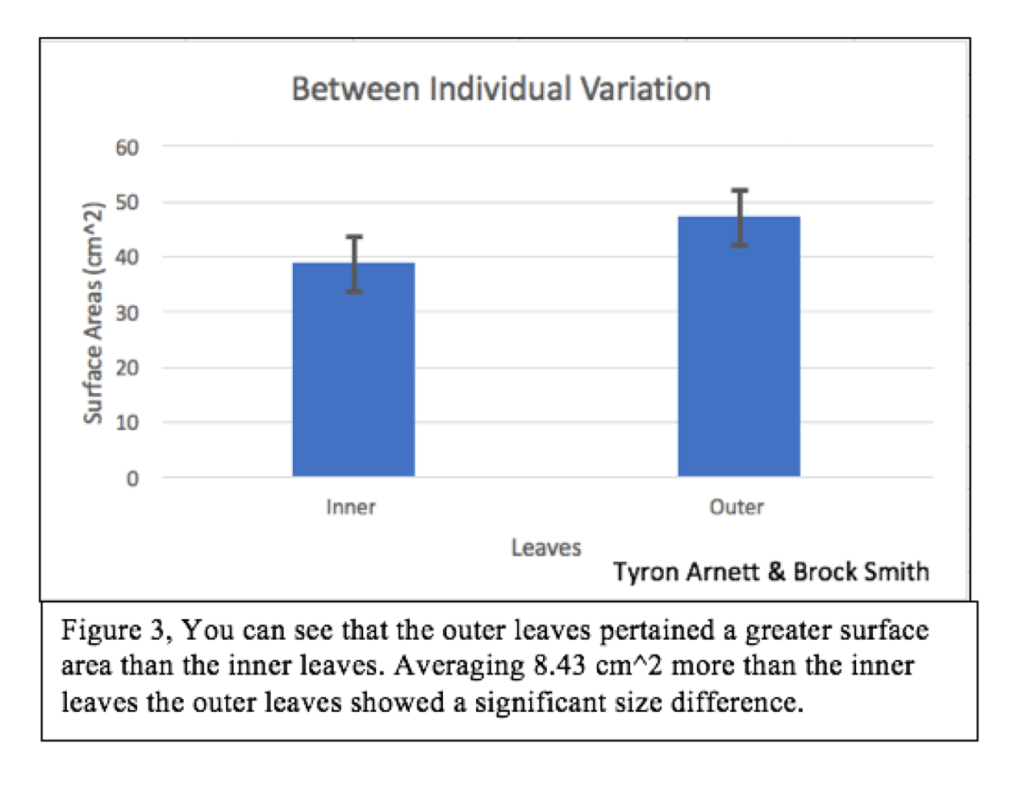
In this week’s lab, we explored the adaptation of oak leaves. There are different sized leaves on different zones of the oak tree. Trees must balance the intake of sunlight and heat. Trees want to maximize the intake of sunlight while not taking in too much heat. Canopy trees are typically multi-layered with their leaves whereas understory trees tend to be mono-layered. For our experiment, we analyzed 10 oak leaves from the inner layer of the tree and 10 leaves from the outer layer of the tree. We laid the trees on a 1-cm grid paper and traced their outlines. We then colored in and counted the squares that were within stated outline. We used this data in a T-test and also created a separate T-test combining our results with the rest of the class. We also used the group data to make a bar graph. The bar graph shows average surface areas for each location of leaf. In the second part of our lab we learned about an experiment performed in order to make inferences about why genetic variation is still present in populations under the effect of natural selection.


PART I
1.) What was the ecological significance of the concepts we discussed in lab today? Distinguish between within individual variation and between individual variation.
-Within Individual Variation: The variation is unique to the individual, it can be adaptive and also represent the result of natural selection. The variation is a continuing phenomenon for the individual and is unpredictable each time an individual embarks on foraging.
-Between Individual Variation: Individuals with different phenotypes will experience differences in survivability and reproduction. Also has variations among populations.
2.) What was your hypothesis for today’s lab? Provide justification for your hypothesis.
-Due to the position of the leaves on the tree, the outer leaves will have a greater surface area than the inner leaves. Due to leaves on inner layers receiving less light than those on outer layers.
3.) Briefly describe how you captured your measurements.
-We laid the leaves on gridding paper and traced their outline. After getting the outline, you then count the number of centimeters inside the leaf outline. Count all squares and also partial ones that has more of the square uncovered. Stems are not included in the area of the leaves. This method will be used to record the surface areas of both outer and inner leaves separately.
4.) Summarize your results. How does your individual results compare to the class results? Which dataset reflects within individual variation and which reflects between individual variation?
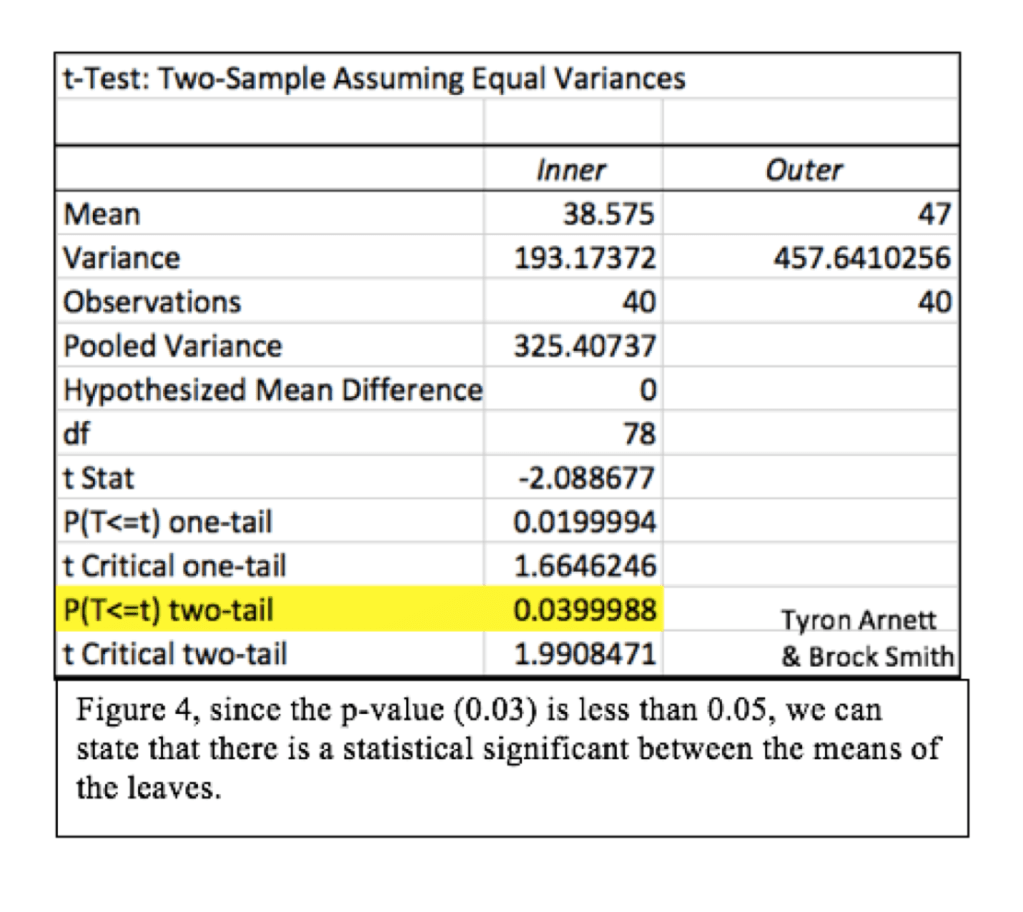
-The Within Individual Variation represents individual results. The Between Individual Variation represents the class results. In my individual data results, outer leaves (39.8 cm^2) had a greater surface area average than inner leaves (26.1 cm^2). Also, since the p-value (0.001) is less than 0.05, we can state that there is a statistical significant between the means of the leaves. In the class results, the outer leaves (47 cm^2) had a greater surface area average than inner leaves (38.5 cm^2). Also, since the p-value (0.03) is less than 0.05, we can state that there is a statistical significant between the means of the leaves.
5.) Explain why ecologists would be interested in understanding within-individual variation in trees.
-By understanding the within-individual variation in trees, ecologist would be able to justify how well the tree is doing in the environment. The variation within species that is produced by natural selection and different components may likewise influence that very environment. Various intraspecific competition within the tree may have natural impacts that are as particular as those of separate species.
6.) Why might crop scientists or farmers want to know how much variation there is in leaf surface area? Use the peer review literature to support your argument.
-Understanding variation would help farmers know where to or where not to plant their crops. From seeing a leaf with a bigger surface area from another, you could interpret that the bigger leaf is using more of the available resources than the smaller leaf. Light is consumed by leaves and differences in surface area exposed to light can change the paces of photosynthesis. “variation within individual organisms corresponds to variation within and among species” (Spriggs, 2018).
PART II
Read the science article, “In Science: Wildflowers combat climate change with diversity” and answer the following questions.
1.) According to Puzey, why does genetic variation persist in the wildflower population under study?
-Puzey states that genetic variation persists in the wildflower population due to factors such as climate fluctuation. He says the flowers have adapted genetic variation to be able to quickly adjust to these changes so that all individuals do not go extinct.
2.) How did the study authors address this question?
-They decided to conduct an experiment to test their fitness. They monitored seep monkey flowers over the span of two years. They measured the plants’ fitness, amount of seeds produced, how well each flowered, and if they were even able to mature to the point of reproduction.
3.) How might you explain the study’s key finding to a general audience?
-The findings clearly indicate that the plant’s fitness is completely dependent on their surroundings each year. The genetic variability allows for the plants success to ebb and flow depending on which trait is ideal for the conditions of the year.
4.) What are the implications of the study’s findings to environmental issues such as climate change and ecosystem disturbance?
-This shows that organisms are adjusted and adapted more to its ecosystem than one might guess. Organisms aren’t just adapted to one condition. They are adapted to a normal range of conditions that the genotype can adjust to. If an ecosystem or climate is changed drastically the organism loses this natural back and forth sway between ideal phenotypes that preserves genotypic diversity. This can cause a species to go extinct due to a phenomenon that selects against the genotype that has been forced to be prominent.
Tyron Arnett is responsible for the graphs, part I, and the reference. Brock Smith is responsible for the Introduction paragraph and part II.
 Tyron & Brock BIOL 3070