Tyron Arnett
Brock Smith
3-1-20
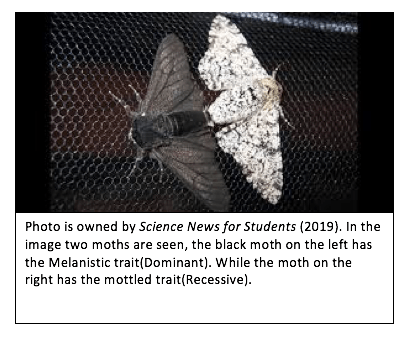
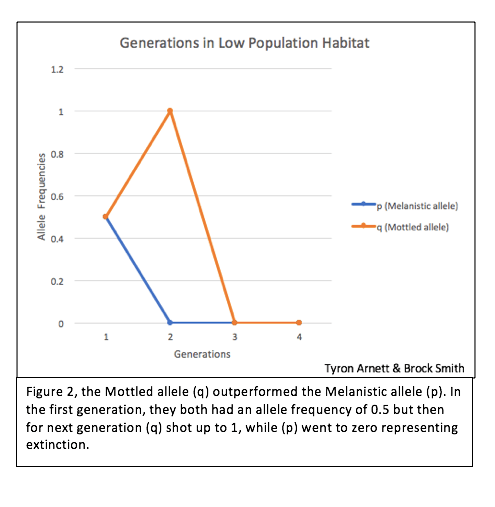
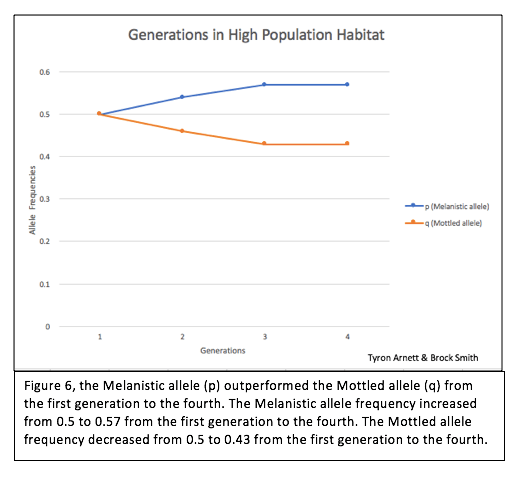
In this week’s lab, we performed a Hardy-Weinberg Simulation. The Hardy-Weinberg Law proposes that allelic frequencies will remain constant across generations. The Hardy-Weinberg Law works around a set of basic assumptions. The Hardy-Weinberg assumptions are that the population is large, no gene flow is occurring with other populations, little to no mutations, only random mating is occurring, and no natural selection is acting upon the population. Therefore Hardy-Weinberg Law does not account for factors such as small populations, adaptations, natural selection, or non-random mating. The equation for the Hardy-Weinberg Law is p^2+ 2pq + q^2= 1.0. P and Q stand for individual alleles. P^2 stands for homozygous dominant. 2pq stands for heterozygotes. Q^2 stands for homozygous recessive. In our experiment, we wanted to simulate the change in allele frequencies within a population of Peppered Moths due to selection caused by pollution. This acknowledgement of natural selection is breaking one of the principles of the Hardy-Weinberg Law. We tested the three genotypes of Homozygous Melanistic, Heterozygous Melanistic, and Homozygous White. We had poster boards that simulated the environments of low pollution, moderate pollution, and high pollution. After each simulation of predation on a generation we would utilize the Hardy-Weinberg formula to calculate the number of individuals for the following generation. We carried out Moderate and High pollution populations four generations and we carried out the Low pollution population two generations because the population crashed. In our data, we came to the conclusion that genotypes shift to the homozygous recessive arrangement in low pollution environments and the homozygous dominant arrangement in the moderate pollution environments. However, the allelic ratios tended to stay consistent in the high pollution populations. In part 2 of our lab we learned about the domestication of wild foxes in a genetic experiment in comparison of the domestication and selective breeding of dogs.



QUESTIONS
1.) Which genotype performed well in your simulation? How did the environment influence survivability?
-MM (Homozygous Dominant) and Mm (Heterozygous) both performed well in the stimulation. Although as environmental setting changed so did the data for each. In the moderate pollution, the genotype MM (Homozygous Dominant) stood out drastically increasing from the first generation to the fourth. In the high pollution environmental setting, the Mm (Heterozygous) genotype stood out amongst all three, staying at a steady 0.5 genotype frequency. With the MM (Homozygous Dominant) increasing from 0.25 to 0.32. Due to high pollution, mm (Homozygous Recessive) genotype was more vulnerable which resulted in decreasing numbers decreasing for them except in the low pollution environmental setting.
2.) How did the allele frequencies vary across generations? How did the environment influence the allele frequencies?
-The “p” (Melanistic) allele increased through the 4 generations in the high and moderate pollution environmental setting. Due to it being the dominant trait, it was more acceptable to survive in the environment. Opposed “q” (Mottled) allele representing the recessive trait of the moth. Due to the moth being in the mottled form in the moderate and high pollution environmental settings, results negatively display the allele at a constant decline. From the moth being in the lighter in the dark environment setting, they were vulnerable to predation.
3.) How did the relative fitness of your genotypes change from the first generation to the last generation? What do your results suggest about the organisms’ ability to survive?
-As generations passed, relative fitness improved because they produced more offspring’s than the previous generations. The data displayed that fitness improved and can be seen from the before selection results. After interpreting the data, you can see that the number of each allele increases, meaning the moths were able to produce more offspring for the next generation following after natural selection. The data also suggested that more acceptable a trait was to an environment the more you’d see that trait be passed on to next generation.
4.) Read the article, “Man’s new best friend? A forgotten Russian experiment in fox domestication”, available on Canvas. Explain how Belyaev selected for tame foxes. Describe some of the expected and unexpected changes that occurred in the foxes over generations. What do the changes suggest about artificial selection?
-Belyaev conducted an experiment of domestication in foxes. Belayaev selected for tameness through the actions of the foxes. For example, he bred the foxes that showed the least amount of fear and most amount of interaction with the experimenters. The results of the artificial selection through generations experiments produced domesticated foxes that liked to be around their caretakers and even tried to attract attention from them through communication. These foxes also exhibited extended reproductive seasons, changes in fur coloration, loss of muskiness, changes in skull structure, short and curly tails, and floppy tails. They also experienced physiological changes. The main being a change in the hypothalamic-pituitary-adrenal axis. The domesticated foxes produced way less adrenaline which made them less afraid of humans. Changes such as less fear and ear changes were expected by Belyaey but he was shocked by the change in their fur coloration. As Garland, Zhao, and Saltzman said in their 2016 article Hormones and the Evolution of Complex Traits: Insights from Artificial Selection on Behavior. “Although behavior may often be a fairly direct target of natural or sexual selection, it cannot evolve without changes in subordinate traits that cause or permit its expression” (Garland, 2016). These changes both expected and unexpected imply that artificial selection can affect way more than just the one selected trait. Other traits are sometimes linked to the ones that we select and will adjust accordingly as we alter their counterparts.

 Tyron & Brock BIOL 3070